
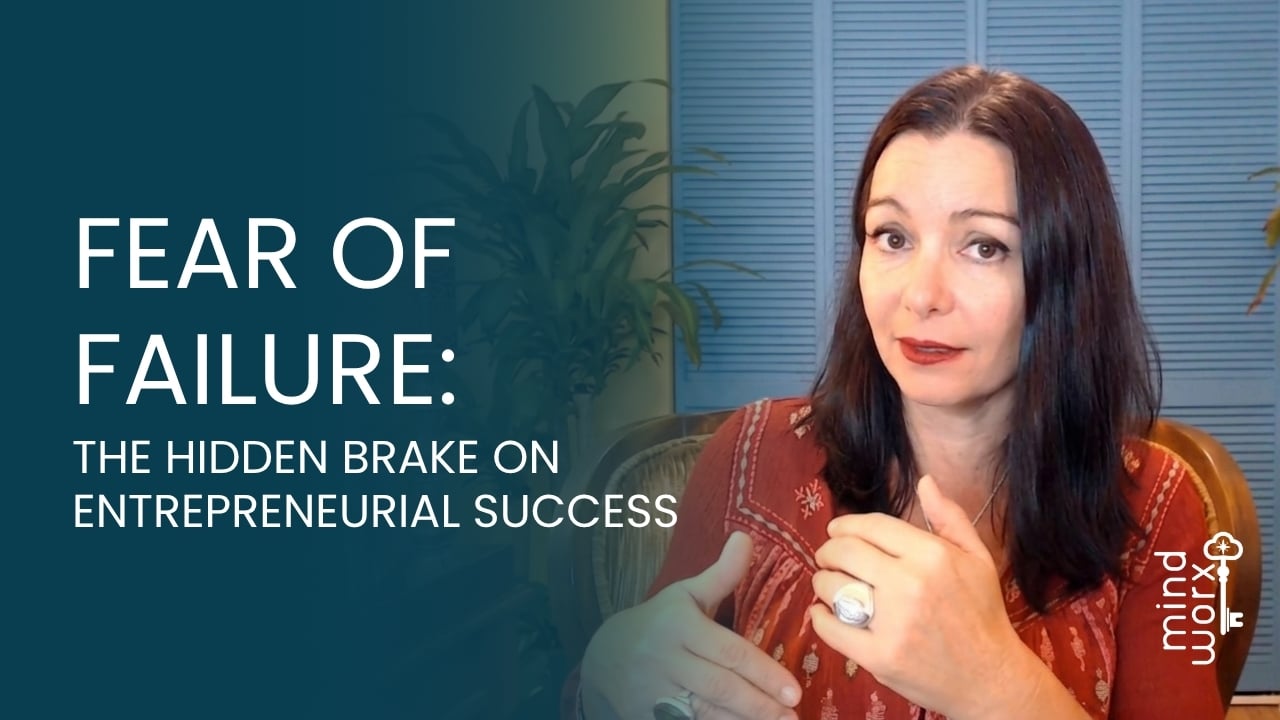
If you have a big idea, a big dream, or a business you know could become so much more, but you keep finding reasons not to move, there may be something deeper going on. Fear of failure has a sneaky way of putting your foot on the brake while your conscious mind is screaming, “Go!”
Fear of failure doesn’t always look like hiding in the corner and refusing to take risks.
Sometimes it looks like perfectionism.
You keep tweaking the presentation. You keep refining the offer. You keep learning, researching, preparing, and getting everything “just right.”
Except nothing ever gets out the door.
Sound familiar?
When you’re focused on figuring out how not to get something wrong instead of figuring out how to do it brilliantly, that’s a very different way of operating.
And it can keep an incredibly capable person stuck.
The Invisible Glass Ceiling Is Often in Your Mind
I’ve seen this over and over again in business.
You have an idea that could bring in more income, but you don’t act on it.
You want to go live, speak publicly, make connections, or put yourself out there, but something holds you back.
Maybe you stay quiet so nobody can see you fail.
Maybe you stay on one back foot, pretending you’re not really trying.
Maybe you’ve built a successful business, but you’ve reached a ceiling, and you’re afraid that pushing beyond it will expose you somehow. If that sounds familiar, you may be dealing with hidden prosperity blocks keeping you overqualified and underpaid, the same invisible ceiling showing up in a different form.
That’s the invisible glass ceiling.
And it’s in your mind, not the boardroom.
You can’t build the juicy dream life you want while simultaneously keeping your foot on the brake.
Your Subconscious May Still Be Protecting an Old Version of You
Here’s where this gets really interesting.
You may know exactly where your fear came from.
Perhaps you were criticized when you made mistakes. Perhaps perfection was expected of you. Perhaps something happened when you were younger that taught your subconscious, “Don’t do that again.”
And now, as a capable adult, you can still be operating through those old grooves in the mind.
It’s not because there’s something wrong with you.
You’re not broken.
That younger part of you learned a way to stay safe. But it doesn’t necessarily mean that you’re an adult now, with different choices, different resources, and a completely different capacity to handle life. I went through my own version of this, and I share more about that journey on my about page.
Your subconscious mind is simply working from the programming it learned.
And programming can change.
You Don’t Have to Succeed Perfectly to Move Forward
One of the most powerful things we can remember is that failing isn’t necessarily failure.
Think about a baby learning to walk.
They take a step. They fall on their bum. They get back up.
Nobody says, “Well, clearly walking isn’t for you.”
They try again.
That’s how we learn.
But somewhere along the way, many of us became far less kind to ourselves. A mistake became evidence that we weren’t good enough. Trying something new became a potential source of shame.
So we stopped trying.
And that can become one of the most exhausting patterns of all: having a dream while refusing to fully pursue it. If exhaustion has become part of your everyday operating mode, it may be worth exploring burnout recovery hypnotherapy alongside the fear itself.
You are far more powerful than you’ve been led to believe.
What if Your Mind Could Work for You Instead?
This is why I love hypnosis.
Hypnosis helps you get past that conscious gatekeeper and work with the subconscious mind, where those old patterns live.
Think of hypnosis as meditation with a goal.
You’re not trying to force yourself to become fearless. You’re allowing your mind to learn something different.
“I can do it.”
Four very simple words.
The goal isn’t to believe you’ll never make a mistake. It’s to know that if you do, you’ll learn, adjust, and keep going.
That’s confidence.
And when you stop treating every possible failure as a threat, you can finally take your foot off the brake.
You can move forward with more confidence, more curiosity and far less wasted energy. This is the same subconscious shift I work through with clients in hypnosis for success sessions.
That’s where prosperity without sacrifice begins.
If fear of failure has been keeping you on the back foot, you don’t have to keep living that way. You can begin to work with the mind that’s been quietly running the show and start creating new programming for success.
If you’re ready to explore what that could look like for you, I’ve created a place to start.
Prosper Now: Begin Reprogramming Your Mind for Prosperity
Frequently Asked Questions
What causes fear of failure in entrepreneurs?
Fear of failure usually comes from old subconscious programming, often shaped by criticism, high expectations, or past experiences that taught you mistakes weren’t safe. That programming keeps running long after the original situation is gone, showing up as hesitation, perfectionism, or self sabotage.
Is perfectionism actually a form of fear of failure?
Yes. Perfectionism often shows up as over preparing, over researching, or endlessly refining something so it never has to be judged as finished. It feels productive, but it’s frequently fear of failure in disguise, keeping ideas and offers from ever going live.
Can fear of failure hold back a business that’s already successful?
Absolutely. Many entrepreneurs hit an invisible glass ceiling where the business plateaus, not because of market conditions, but because pushing further feels exposing. This ceiling lives in the mind, not in the boardroom.
How does hypnosis help with fear of failure?
Hypnosis works with the subconscious mind, where fear based patterns and old protective programming actually live. Rather than relying on willpower or mindset tricks, it helps reprogram the underlying belief so confident action starts to feel natural.
Do I need to eliminate fear of failure completely to succeed?
No. The goal isn’t fearlessness, it’s knowing that if you do make a mistake, you can learn, adjust, and keep going. That shift, from avoiding failure to trusting your ability to recover, is what builds real confidence.
How many sessions does it typically take to shift fear of failure patterns?
It varies by person and by how deeply the pattern is rooted, but many clients notice meaningful shifts in just a few sessions using rapid transformational therapy, since it works directly at the root of the pattern instead of just managing symptoms.
