
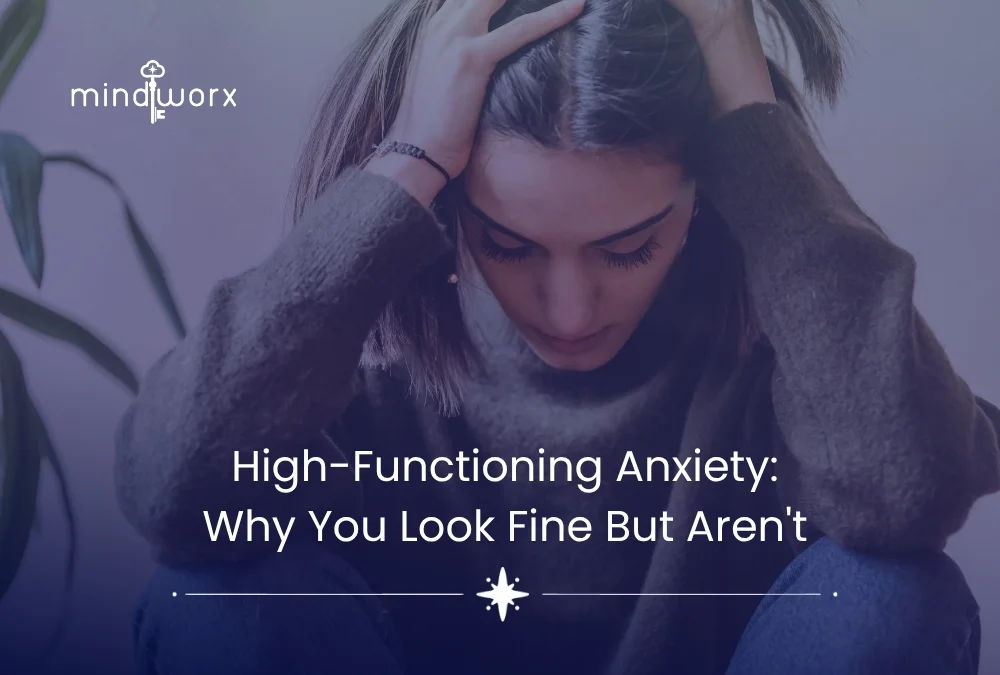
You show up. You deliver. Everyone thinks you have it together, and most days, you can almost convince yourself too. Underneath it? You feel like you’re drowning quietly, in a room full of people who have no idea.
I know that feeling intimately, and it’s part of why I do this work. Let’s talk about what’s actually going on.
This Has a Name, and It’s Not Weakness
High-functioning anxiety is exactly what it sounds like: anxiety that coexists with real competence and real achievement. You meet every deadline. You still feel a constant hum of dread underneath it. Both things are true at once, which is precisely what makes this so hard to name and so easy to hide.
That duality is also exactly why so many high achievers carry it for years without addressing it. If you’re still delivering, it doesn’t count as a problem, right? Except your body keeps the score. The National Institute of Mental Health notes that anxiety involves more than occasional worry: it doesn’t go away, shows up in many situations, and can get worse over time, even when your performance looks perfectly fine.
What’s Happening in Your Nervous System
Underneath that composed exterior, your nervous system is likely staying on high alert far more than it should. Holding it together takes energy. A lot of it. Which is exactly why you can look completely fine and still feel utterly depleted by 3pm.
This is chronic stress in action: a system running on high alert, quietly, for so long it starts to feel normal. It is not normal, just familiar.
Familiar is not the same as sustainable. The body keeps score even when the calendar looks fine, and eventually the bill comes due, usually as exhaustion, insomnia, or a health scare nobody saw coming.
Comparisonitis Makes It Worse
Here’s the trap. Because you look fine, and everyone around you seems to be handling it too, you assume you’re the only one white-knuckling it behind a calm face. That’s comparisonitis, and it keeps the negative forecaster of doom running the show, convincing you that admitting this would mean admitting failure.
It wouldn’t. It would mean you’re finally ready to address something that’s been running since long before your current success.
I promise you, the room is full of people wearing the exact same mask. Comparisonitis just makes sure none of you compare notes.
Getting to the Root of It
This is subconscious programming, often installed years before your career even started, which is exactly why willpower and productivity systems haven’t touched it. If you’ve blamed yourself for that, why willpower isn’t the fix for high-achieving women explains why it was never about effort.
Hypnotherapy for anxiety and stress works underneath the mask, at the level where this pattern actually lives, so the calm you show the world starts matching what’s happening inside it too.
Think of hypnosis as meditation with a goal. Except the goal here isn’t just relaxation. It’s retraining the pattern that built the mask in the first place.
What It Feels Like When It Shifts
Clients describe it as the volume finally coming down. Not silence, just quiet enough to hear their own thoughts instead of the constant hum of dread underneath them. Sleep gets easier. The 3pm crash gets smaller. The version of them that everyone else already sees, capable, composed, together, finally starts to feel true from the inside too.
That’s not a small change, that’s the mask finally becoming unnecessary.
You are far more powerful than you’ve been led to believe, and you deserve to actually feel that way, not just perform it.
Frequently Asked Questions
What is high-functioning anxiety, exactly?
It’s anxiety that exists alongside real competence and outward success, meeting deadlines and appearing composed while carrying constant internal dread. Both the achievement and the anxiety are real at the same time.
How do I know if I have high-functioning anxiety versus regular stress?
Regular stress tends to ease once the specific stressor passes. High-functioning anxiety tends to persist as a baseline hum of unease, regardless of how well things are objectively going.
Why can someone with high-functioning anxiety look completely fine to others?
Because the nervous system works hard to maintain composure, which takes real energy but is often invisible from the outside. The mask can be very convincing, even to the person wearing it.
Is high-functioning anxiety a real, diagnosable condition?
It’s a widely recognized pattern rather than a formal clinical diagnosis on its own, though it often overlaps with generalized anxiety. What matters most is addressing the underlying pattern, whatever it’s called. If anxiety is affecting your daily life, it’s also worth talking with a licensed mental health professional.
What are the hidden costs of high-functioning anxiety over time?
Chronic stress takes a real physical toll over time, showing up as fatigue, disrupted sleep, and eventually burnout, even while outward performance stays strong.
How is high-functioning anxiety connected to burnout?
They share the same root: a nervous system stuck in overdrive. High-functioning anxiety left unaddressed is often the pattern that eventually tips into full burnout.
You Don’t Have to Keep Performing Calm
The exhaustion under the mask is real, and it’s addressable, at the root, not just the surface.
Book your free consultation and let’s talk about what’s actually underneath it.